
Visa Refusal Guide
Why Visas Get Rejected and What to Do Next
02-Nov-2026
Have you ever had your plans go awry because of a single email? A visa refusal can leave you disappointed, confused, and unsure of your next steps. If you are an Indian applicant, remember that a refusal does not automatically end your international plans.
Whether you want to study abroad, visit your relatives, find new career opportunities, etc., you need to understand the reasons behind the refusal. Your next application should include not only additional documents but also answers and information that address the issues in your first application.
However, every country follows different immigration rules. What is acceptable in one country may be unacceptable in another. Be aware of this before submitting your next application.
This visa refusal guide explains the reasons for your rejection, each country’s specificities, and how to understand the refusal letter. It is ideal for parents planning their children’s international education.
Keep reading to know what went wrong and how to proceed.
Table of Content
1. Why Do Visa Applications Get Refused?
2. Canada: Address Your Study Permit or Visitor Visa Concerns
3. USA: Understand Section 214(b) Before Reapplying
4. Europe: Check Schengen Visa Requirements Carefully
5. UK: Understand Financial Evidence and CAS Requirements
6. Australia: Meet the Genuine Student Requirement
7. Dubai: Avoid Common Tourist Visa Application Mistakes
8. Your Visa Was Refused. What Should You Do Now?
9. How Can You Reduce Your Chances of Visa Refusal
10. How Neximm Immigration Can Help After a Refusal
11. Conclusion
12. FAQs
1. Why Do Visa Applications Get Refused?

Several issues typically affect visa applications, though the rules differ by country. By understanding these problems, you can see where you feel short and prepare for the next time you apply.
- Lack of financial evidence: Your bank account, income statements, or financial sponsor might not show enough money. If you see any large unexplained deposits, it’s a red flag as well.
- Incomplete documentation: Your application might weaken by missing documents, conflicting dates, unclear documentation, or incorrect translations.
- Unclear purpose: Your study plans, itinerary, accommodation, or reason for visiting must match your visa category.
- Weak home-country ties: Decision-makers may question whether you intend to leave when your authorized stay ends.
- Poor interview performance: Cryptic answers or contradictions may raise doubts about your intentions.
- Misrepresentation: Using a false document or providing false information on purpose can have serious consequences.
- Undeclared refusals: Refusals you don’t report when asked can make you look untrustworthy.
Please read all documents and declarations before reapplying. Your evidence should present a single story that is believable and credible.
2. Canada: Address Your Study Permit or Visitor Visa Concerns

Students, visitors, workers, families, and others may be impacted differently by a canada visa rejection. The officer evaluates your admission, finances, study plans and circumstances for study permits. Insufficient proof of funds or unexplained financial deposits can also weaken your application.
Your documents should include details of tuition, living costs and where you’re funding from. You also need to show why the program you selected fits your background and aspirations.
Additionally, officers may assess whether you will leave Canada when required. This does not mean you must prove you will never immigrate. Instead, you must meet the applicable temporary resident requirements.
What is the next step?
Read the refusal letter and officer decision notes. List the concerns, then reinforce your financial evidence, study rationale or supporting documents. For expert advice, seek advice from qualified canadian immigration consultants, or an authorized immigration representative. If the concerns remain and you resubmit the application without addressing them, you may receive another refusal.
To better understand your refusal and prepare for your next steps, consult these official Government of Canada resources for guidance on study permits, visitor visas, financial documentation, and reapplication procedures.
| Official Resource | What Readers Can Find |
|---|---|
| Officer Decision Notes | Understand the specific reasons behind an immigration application refusal. |
| Study Permit Document Checklist | Review study permit documents, including the letter of acceptance and proof of funds. |
| Proof of Financial Support | Learn which documents can demonstrate financial capacity for studying in Canada. |
| IRCC: Reapplying After a Visitor Visa Refusal | Understand when reapplying may make sense and why addressing the original refusal matters. |
| Visitor Visa Eligibility | Review the eligibility requirements for a Canadian visitor visa. |
| Official Canadian Visa Guidance for Applicants from India | Find Canada-specific guidance for applicants applying from India, including warnings about unauthorized representatives. |
3. USA: Understand Section 214(b) Before Reapplying

If your b2 visa rejected search brought you here, start by understanding the decision. Applicants for most nonimmigrant visas are presumed to be intending immigrants under Section 214(b) of the US Immigration and Nationality Act (INA) until they demonstrate eligibility for temporary status.
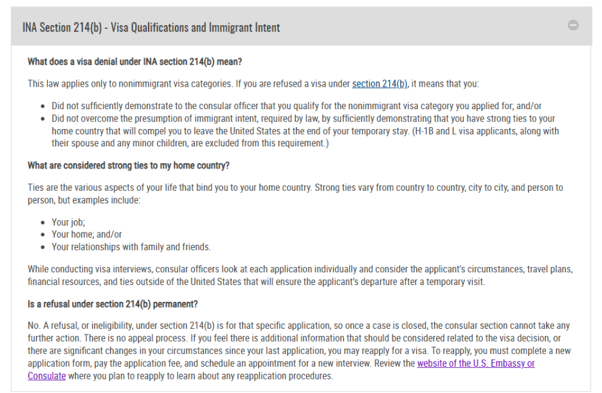
A visitor visa applicant must prove eligibility for the intended visit. The assessment may be affected by your reason for travel, your financial situation and your connections to the outside of the United States. But no single document guarantees approval.
If you were denied a US visa under Section 214(b), there is generally no appeal process for that decision. Re-application is possible, but meaningful new information or changed circumstances should be presented.
What should you do next?
Review your DS-160 answers, travel plans, and interview responses. Be consistent about your employment, finances and visit purpose. Give brief, honest responses that state your plans and why you are returning to India. If you are given another refusal reason, refer to the relevant legal provision, as the procedure may differ.
4. Europe: Check Schengen Visa Requirements Carefully
Planning to explore the Schengen visa countries? You must meet the requirements of the country that will be evaluating your trip. Common issues include insufficient funds, lack of travel insurance, unclear plans, and unconfirmed accommodation.
A purpose for the visit and evidence for your planned visit must be demonstrated. Your travel insurance should comply with Schengen area requirements. Your documents should also prove the credibility of your travel plan and your financial arrangements.
If you are intending to travel to Switzerland, for instance, then you should look at the current requirements for Switzerland visas. Switzerland participates in the Schengen Area, but your application route depends on your itinerary and main destination.
Timelines shown are approximate dates, not hard deadlines. Application periods and visa processing times vary according to destination. As such, please refer to your university’s official calendar for precise deadlines and the relevant immigration authority’s current guidelines.
What should you do now?
Read the reasons for the refusal and identify the missing evidence. Make sure your travel plans, insurance, lodging and/or budgets are in order before reapplying. If you are considering a Turkish visa rejection, remember that Turkey has separate visa rules. A Schengen refusal and a Turkish visa decision are distinct matters.
If your Schengen visa has been refused, consult official European Union and government resources before submitting another application. These websites can help you verify the applicable requirements, understand the refusal process, and identify the next steps relevant to your destination.
| Official Resource | What Readers Can Find |
|---|---|
| European Commission – Applying for a Schengen Visa | Application procedures, required documents, fees, processing times, and refusal information. |
| European Commission – Schengen Visa Policy | General information about Schengen visa rules and policies. |
| EU Visa Code – EUR-Lex | The legal framework governing Schengen visa applications, supporting documents, and visa decisions. |
| Swiss State Secretariat for Migration – Entry with a Visa | Switzerland’s official entry requirements, including travel documents, purpose of stay, and financial means. |
| Swiss State Secretariat for Migration – Visa Refusal Appeals | Information about challenging a Swiss visa refusal and the applicable procedure. |
5. UK: Understand Financial Evidence and CAS Requirements
A UK visa refusal can affect students, visitors, workers, and family applicants. If you are applying for a student visa, you need a Confirmation of Acceptance for Studies (CAS) and financial evidence that meet the requirements.
You might be required to show proof of financial resources for tuition and expenses. The evidence must meet all applicable rules, including the financial documentation requirements and holding period. Refusals can occur if the amounts are incorrect, evidence is missing, or there are inconsistencies.
Family applicants are advised to also check the specific route requirements. One of the most common reasons for a search of refused spouse visa uk or spouse visa refusal uk is due to issues regarding relationship evidence, financial eligibility, English-language requirements, or missing documents.
What is the next step?
Review the precise reasons for the refusal and what you could do about it for your visa class. Depending on the decision, an administrative review, an appeal or a new application may be considered. Not all refusals have the same remedy: check what your options are before you act.
If your UK visa application has been refused, start by reviewing the official GOV.UK guidance relevant to your visa category. These resources can help you verify financial requirements, check supporting documents, and understand whether you can reapply or pursue an eligible review.
| Official Resource | What Readers Can Find |
|---|---|
| GOV.UK – Student Visa | Eligibility criteria, Confirmation of Acceptance for Studies (CAS), and student visa application requirements. |
| GOV.UK – Student Visa: Money You Need | Financial requirements for tuition fees and living costs, including applicable evidence rules. |
| GOV.UK – Standard Visitor Visa | Eligibility requirements and application guidance for people visiting the UK. |
| GOV.UK – Visa Administrative Review (Outside the UK) | Information about requesting an administrative review if your refusal decision is eligible. |
| GOV.UK – Immigration Appeals and Status Problems | Official guidance on appeals, reviews, and other immigration decision procedures. |
6. Australia: Meet the Genuine Student Requirement

If you are applying for a place to study in Australia, your application must meet the Genuine Student (GS) requirement. Decision-makers consider whether your circumstances, course choice, and study intentions support your application.
Your statement should describe your choice of course/institution and why. It should also link your past learning, experience and plans. General answers might not answer the questions.
Financial proof is also crucial. You must meet requirements for funds and living expenses, along with other supporting documents. Evidence of English proficiency and academic readiness may also be relevant, depending on circumstances.
What action can you take?
You need to check your application against the reasons for refusal and the Department of Home Affairs’ current requirements. Make your explanation more specific and concrete. If you’re looking into student aid, do some research on scholarships, education loans, and financial assistance. Keep in mind that visa evidence is required and will not be waived for funding support.
If your Australian visa application has been refused, consult official government resources to understand the reasons for the decision and identify the requirements relevant to your visa category. These resources can help you review the Genuine Student criteria, financial evidence requirements, and any available review options before deciding on your next steps.
| Official Resource | What Readers Can Find |
|---|---|
| Australian Department of Home Affairs – Student Visa (Subclass 500) | Student visa eligibility, application requirements, visa conditions, and refusal information. |
| Department of Home Affairs – Genuine Student Requirement | How applicants should explain their circumstances, course choice, educational goals, and reasons for studying in Australia. |
| Department of Home Affairs – Visitor Visa (Subclass 600) | Visitor visa eligibility, application requirements, and supporting evidence for tourism or family visits. |
7. Dubai: Avoid Common Tourist Visa Application Mistakes

Dubai visa rejections can disrupt holidays, family visits, and business travel. Any application may be rejected due to inaccurate personal information, missing paperwork, unclear travel plans, or problems found during the immigration process.
Similarly, Dubai tourist visa rejections may occur when the submitted information does not satisfy the relevant requirements. An application might also be impacted by past immigration offences or unaddressed overstay concerns.
However, refusal reasons vary depending on the applicant’s circumstances and the processing authority. No single explanation applies to all cases.
What should you do next?
Request the necessary visa refusal information from the appropriate visa sponsor or visa processing channel. Review the information on your passport, your application and your supporting documents. If there are identifiable errors, correct them before submitting again. If the reason remains unclear, seek guidance from an authorized provider. Do not submit more than one application unless you understand the process.
If your Dubai tourist visa application has been refused, consult official UAE government and immigration websites before applying again. These resources can help you verify the applicable entry requirements, review the required documents, and identify the appropriate authority or application channel for further guidance.
| Official Resource | What Readers Can Find |
|---|---|
| UAE Government – Tourist Visa | Tourist visa options, application channels, eligibility information, and general requirements. |
| UAE Government – Do You Need a Visa? | Information on whether your nationality requires a visa in advance or may qualify for visa-free entry or a visa on arrival. |
| General Directorate of Residency and Foreigners Affairs (GDRFA), Dubai – Tourist Visa | Dubai-specific tourist visa application details, documents, conditions, and service procedures. |
| UAE Federal Authority for Identity, Citizenship, Customs and Port Security (ICP) – FAQs | General information on UAE visa requirements, supporting documents, and application channels. |
IMPORTANT: Dubai visa decisions depend on the relevant immigration authority and application channel. The official resources above provide general requirements and procedures; they do not guarantee that a refusal can be overturned, or that reasons for refusal will always be disclosed.
8. Your Visa Was Refused. What Should You Do Now?
A refusal is daunting, especially when you have paid application fees or made plans with your family. Nevertheless, you can take steps to address the situation.
Step 1: Understand the specific reason.
Read your refusal letter in detail. See whether it mentions missing information, eligibility issues, credibility, or any other grounds.
Step 2: Resolve the underlying issue.
Gather any missing documents, clarify your financial transaction, resolve any inconsistencies, or strengthen your argument. Do not duplicate your previous application.
Step 3: Decide on the proper solution.
Depending on the country and visa category, you might reapply, request an administrative review, or pursue an appeal. Some decisions offer limited remedies or strict deadlines.
Step 4: Consider your alternatives.
You may reschedule your departure date, revise your study program, or choose another country. Changing countries will not erase your previous refusal. Disclose it wherever required by your application.
Step 5: Seek professional assistance when needed.
When your refusal letter is due to complex eligibility requirements, misrepresentation of allegations, or immigration consequences, seek legal advice first.
9. How Can You Reduce Your Chances of Visa Refusal
Approval is not guaranteed, but careful preparation can minimize avoidable errors. This checklist helps you complete your application.
- Passport and forms: Ensure that they are current, contain accurate personal information, have signatures and are consistent throughout all forms.
- Financial documents: Provide the required bank statements, income documentation, sponsorship documents, and explanations for unusual transactions
- Purpose of travel: Give a study plan, visitor itinerary, or explanation based on your visa type.
- Accommodation and insurance: Provide evidence as required by the destination.
- Supporting records: Ensure letters of admission, CAS information, employment records, invitation letters, and relationship evidence as appropriate.
- Preparing SOP: Make sure that you clearly articulate your course selection, career objectives or travel reasons. Be concise and factual in your statement.
- Interview preparation: Practice natural responses to common interview questions. Make sure that you answer in terms of what you have submitted.
- Previous refusals: Declare earlier refusals accurately whenever requested. Don’t try to hide pertinent immigration history.
If you are planning to study overseas, involve your family early in financial planning. Research tuition, housing, scholarships and viable funding opportunities. A realistic budget will enable you to prepare more compelling evidence.
10. How Neximm Immigration Can Help After a Refusal
A visa refusal raises important questions about your next move. Neximm Immigration will guide you through your options and help you organize your application.
Our team can address refusal issues, suggest documentation to include in your Statement of Purpose (SOP) or Letter of Recommendation (LOR), and help improve your SOP or LOR, if applicable. We also offer interview preparation and supporting evidence.
For Canadian immigration matters, our RCIC-led team can help you understand applicable requirements and available options. Representation and services depend on your case and the professional authorized to handle it.
Conclusion
Though a visa rejection may seem discouraging at first glance, it doesn’t mean all international dreams are over.
What matters is finding out why you were rejected, fixing the issue with the right documents, and following the immigration rules of the country you want to visit.
Have questions about your visa refusal? WhatsApp us or email connect@neximmvisa.com today to discuss your next steps with our team.
Let’s work together towards a stronger application and help you move forward with renewed confidence.
FAQs
1. How long after a visa refusal can I apply in Australia?
There is no standard waiting period in Australia after a visa refusal before you can submit another application. In some cases, restrictions may limit how soon the applicant can apply again. Read the refusal letter carefully to understand the reasons for refusal, your rights, and any applicable deadlines to apply again.
2. Which visa has the highest rejection rate?
It is hard to say which visa has the highest refusal rate because it varies by country, visa type, applicant nationality, and time period. For a proper comparison, consult official visa refusal statistics from government websites.
3. How many times can a visa be rejected?
Theoretically, there is no limit toto the number of visa rejections an individual can face, but depending on the destination’s immigration policy, some rules and restrictions may apply in certain situations. For instance, in Australia, some protection visa refusals and certain character decisions may be subject to restrictions.
4. Can I apply immediately after visa refusal?
In many cases, you are allowed to submit another visa application right away after receiving the refusal. However, consider the destination country and visa type. For instance, if you were refused a US visitor visa under Section 214(b), you can reapply for a new visa, taking into account changes in your circumstances. Similarly, you can reapply for Schengen visas, but you should address the reasons for refusal. You need to check whether any appeal or reconsideration procedures apply in your case.
5. What is the most common reason for visa refusal?
It is impossible to point out a common reason that would lead to all visa refusals. Usually, reasons include the inability to prove eligibility for a visa application, lack of evidence concerning finances, doubts regarding the purpose of the trip, and failure to comply with the visa category requirements. If we speak specifically about US visitor visas, then one of the most popular reasons for rejection under Section 214(b) is the inability to prove your eligibility for the visa category.
Have Questions?
Our immigration specialists can help you understand your options and take the next step with confidence.
Share :