

Have Questions?
Our immigration specialists can help you understand your options and take the next step with confidence.
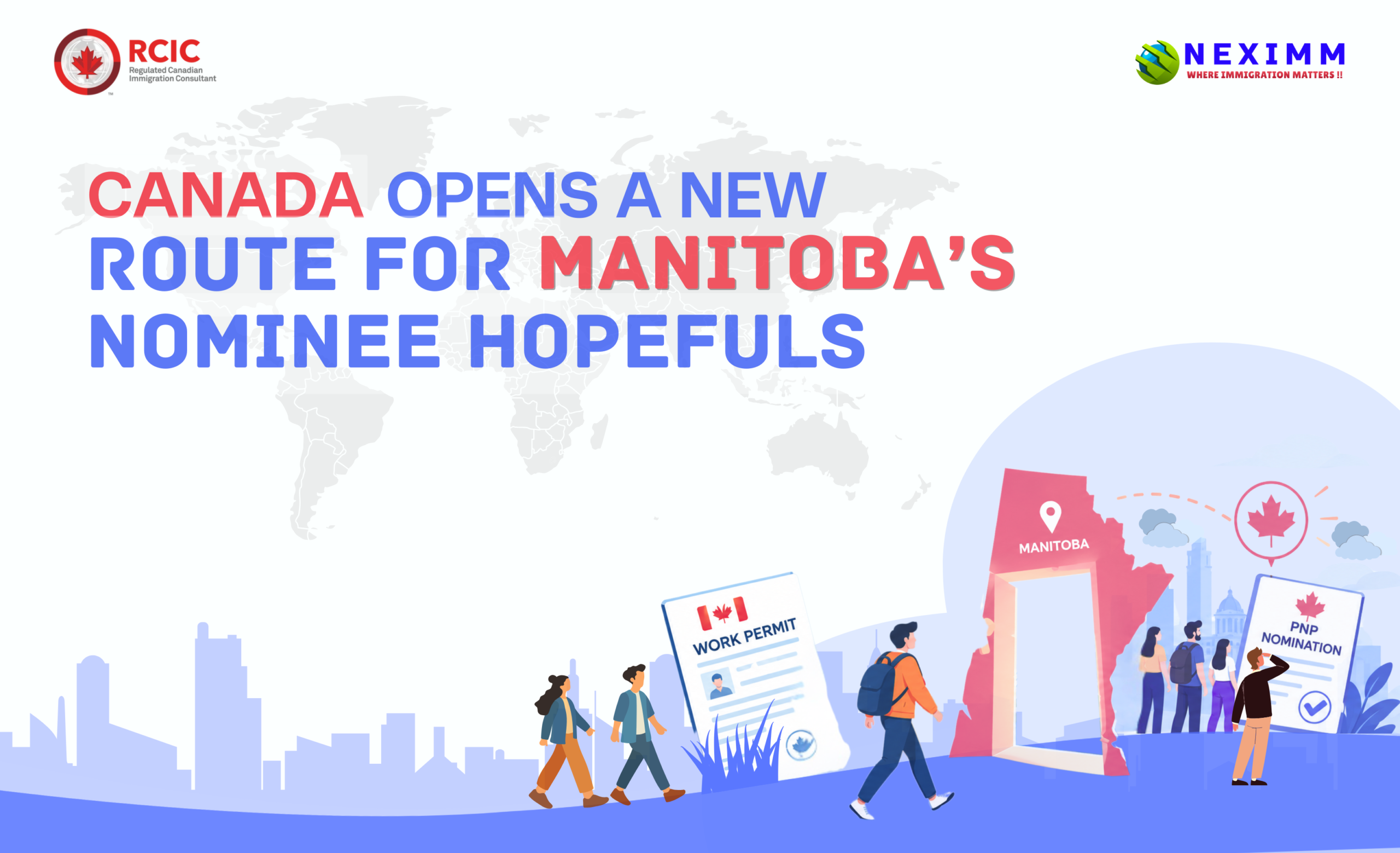
When a temporary foreign worker’s status or work authorization is nearing expiry while they wait for progress in Manitoba’s provincial immigration system, the consequences can be significant. A new federal temporary public policy, the Manitoba Workforce Transition Bridge (MWTB), creates a limited pathway for certain eligible workers to obtain an open work permit and maintain or restore their temporary resident status.
The measure is intended for a defined group of temporary workers in Manitoba who were already in the Manitoba Provincial Nominee Program (MPNP) Expression of Interest (EOI) pool by the end of 2025. It is not a general work-permit option for everyone seeking nomination through Manitoba.
Legal Disclaimer: While we make reasonable efforts to keep the information accurate and up to date, applicants should verify the latest requirements directly with Immigration, Refugees and Citizenship Canada (IRCC) and the Government of Manitoba before taking any action. Eligibility for the Manitoba Workforce Transition Bridge work permit depends on individual circumstances and the specific requirements of the applicable public policy. Reading this article does not create a consultant-client relationship. For advice specific to your situation, consider consulting a qualified Canadian immigration professional.
A Lifeline for Up to 2,700 Workers
Under the MWTB public policy, the Government of Manitoba may support a cohort of up to 2,700 temporary workers for an open work permit. Eligible applicants may receive an open work permit that allows them to work for most employers in Canada, subject to the usual restrictions that can apply to open work permits.
The policy addresses a narrow but important gap: workers who have demonstrated an intention to settle in Manitoba and were placed in the MPNP EOI pool, but who may lose their ability to work before receiving further progress in the provincial nomination process.
This is not a Bridging Open Work Permit (BOWP). A BOWP is generally available only to certain applicants who have already submitted a permanent residence application and meet the applicable federal requirements. The MWTB instead targets certain prospective MPNP nominees who are still waiting in the provincial selection process.
Who Qualifies Under the Support Letter Rules

Eligibility begins with the required Manitoba-issued open work permit support letter. The applicant must have received this support letter on or before December 31, 2025.
The qualifying letter must confirm that the individual was:
- Screened by Manitoba
- Placed in the MPNP Expression of Interest pool on or before December 31, 2025
- Identified by Manitoba as part of the group being supported under this temporary public policy
Applicants should also provide a letter from their current employer confirming their employment in Manitoba.
A 2026 letter of continued support may be issued by Manitoba in some cases. However, where IRCC requires proof that the applicant met the original eligibility deadline, the applicant should submit the qualifying Manitoba support letter issued on or before December 31, 2025, along with any updated letter of continued support.
Importantly, the applicant does not need to have already received an MPNP nomination. The policy is aimed at certain workers who are in the MPNP EOI pool and are awaiting potential selection or further processing.
Three Paths to Eligibility
In addition to holding the required Manitoba support letter and current-employer documentation, applicants must meet one of the temporary-status circumstances covered by the public policy.
The policy is intended to assist eligible individuals who fall within the status categories identified by IRCC, including workers who:
- Hold a valid work permit at the time they apply
- Previously held a work permit that was valid on May 7, 2024, but has since expired
- Applied to extend their work permit on or before May 7, 2024 and have maintained temporary resident status
Applicants must review their status history carefully. A person’s eligibility can turn on the precise expiry date of a previous work permit, whether an application was filed before expiry, and whether temporary resident status was maintained.
Because the public policy is technical and applies only to a specific cohort, applicants should not assume that being employed in Manitoba or having an MPNP profile alone is sufficient.
The Application Process, Step by Step

Eligible candidates should apply online through the IRCC work-permit application process and select the instructions applicable to the Manitoba support-letter public policy.
Applicants should generally prepare and submit:
- A completed work-permit application
- The qualifying Manitoba open work permit support letter issued on or before December 31, 2025
- Any updated Manitoba letter of continued support, if available
- A current letter of employment from the Manitoba employer
- Passport pages, photograph, and other standard supporting documents requested by IRCC
- A valid work permit, if the applicant currently holds one
- A temporary resident status extension application, where required under the public-policy instructions
- A restoration application, where applicable for a person whose status has expired
If the online document checklist asks for a document that is not applicable to an applicant under the MWTB instructions, the applicant should follow IRCC’s direction and upload a brief document marked “Not applicable” in the relevant upload field.
Applicants should retain complete copies of their submission, payment receipt, support letters, and employer documentation. They should also avoid international travel unless they understand the possible effect on their pending application and temporary resident status.
Built-In Exemptions Make the Process More Flexible
The MWTB includes specific public-policy exemptions that may help eligible applicants overcome barriers that would otherwise prevent an in-Canada work-permit or restoration application.
For qualifying applicants, IRCC may exempt certain requirements that would normally apply to:
- Applying for a work permit from inside Canada
- Extending temporary resident status
- Restoring temporary resident status after a loss of status
- Some non-compliance issues connected with prior temporary resident conditions
These exemptions are not automatic and do not eliminate every immigration risk. IRCC officers must still be satisfied that the applicant meets the public-policy requirements and is otherwise admissible to Canada.
For example, prior unauthorized work, unauthorized study, or a breach of permit conditions should be assessed carefully. The public policy may provide relief from specified regulatory requirements, but it does not guarantee approval or override all admissibility concerns, including criminality, medical inadmissibility, misrepresentation, or security issues.
How Long the Policy Will Last
The Manitoba Workforce Transition Bridge public policy took effect in 2026 and is scheduled to remain in force until December 31, 2027, unless IRCC revokes it earlier.
As a temporary public policy, it can be amended, limited, or ended before its stated expiry date. The available number of supported workers is also limited to the cohort identified by Manitoba, up to 2,700 individuals.
Eligible workers should not delay solely because the policy has a future expiry date. A support letter does not replace the need to make a complete and timely application to IRCC.
A Quiet Rollout After Public Announcements

The new measure followed public discussion about the need to protect temporary workers in Manitoba who were at risk of losing work authorization while remaining connected to the provincial nomination system.
IRCC later published the federal public policy and application guidance for eligible Manitoba-supported applicants. Manitoba may also provide updated letters of continued support in 2026 for individuals who received an earlier qualifying support letter.
Applicants should rely on the official IRCC instructions and the terms of their individual Manitoba support letter, rather than relying only on social-media announcements or general news coverage.
Building on a 2024 Precedent
The MWTB follows earlier federal efforts to assist certain provincial nominee candidates facing work-authorization gaps. A previous temporary public policy operated in 2024 for select prospective provincial nominee candidates in Manitoba, Alberta, and Yukon.
The Manitoba policy is distinct from that earlier measure. It has its own eligibility criteria, defined Manitoba support-letter requirements, and a specific cohort of workers who may be supported.
Applicants should therefore avoid using expired 2024 instructions as a substitute for the current MWTB requirements.
Why This Policy Exists: The 2024 Backlog

Provincial nomination is not immediate. Many candidates first create an Expression of Interest profile and wait for an invitation from the province before they can submit a full nomination application.
During this waiting period, temporary workers may face expiring work permits and limited options to remain authorized to work. The challenge can be particularly acute for workers who have built employment histories in Manitoba but have not yet reached the nomination or federal permanent-residence application stage.
The MWTB provides a targeted status solution for a limited group of such workers. It does not change MPNP selection criteria, guarantee nomination, or guarantee permanent residence.
The Bigger Picture: Waiting Without Options
The MPNP EOI pool is an early stage of Manitoba’s provincial immigration process. Being in the pool means a person may be considered for selection, but it does not by itself create permanent resident status, a nomination, or an ongoing right to work in Canada.
Workers who have already received a provincial nomination, submitted a permanent residence application, or received an acknowledgement of receipt may have access to different work-permit options depending on their circumstances. Those pathways may include a provincial work-permit support letter or, where eligible, a Bridging Open Work Permit.
The appropriate strategy depends on the applicant’s exact stage in the immigration process, work-permit expiry date, current status, and available provincial documentation.
A Related Fix from Earlier in 2026
IRCC has also introduced measures intended to address certain work-authorization gaps for provincial nominee applicants at later stages of the permanent residence process.
These measures are separate from the MWTB. The Manitoba Workforce Transition Bridge is specifically designed for a limited, Manitoba-supported group of workers who were placed in the MPNP EOI pool by December 31, 2025.
Applicants should not confuse an EOI-pool pathway with eligibility for a provincial nominee work permit support letter or a Bridging Open Work Permit. Each option has separate legal requirements, timing rules, and document requirements.
Conclusion
Together, these policies signal a broader shift in Canada’s approach. Provincial nominee candidates are gradually gaining more protection against status gaps.
For Manitoba’s foreign workers, the MWTB offers meaningful, practical relief. Those who qualify should review their support letter and permit history closely, and apply promptly given the policy’s uncertain future.
Need Help Understanding Your Manitoba PNP Options? Connect with Neximm Immigration for professional guidance on your Canadian immigration journey.
Email us now at connect@neximmvisa.com.
FAQs
Is IELTS required for Manitoba PNP?
Language-test requirements depend on the specific MPNP stream. IELTS is one accepted English-language test, but applicants may be able to submit results from another test accepted by Manitoba for the relevant stream.
The Manitoba Workforce Transition Bridge itself is a work-permit public policy. Its core eligibility is based on the qualifying Manitoba support letter, EOI-pool placement, employment documentation, and applicable temporary-status criteria rather than a new IELTS requirement.
Who is eligible for Manitoba PNP?
Eligibility for the Manitoba Provincial Nominee Program depends on the stream. Manitoba assesses factors such as employment, work experience, occupation, education, language ability, adaptability, and genuine ability and intention to establish in the province.
Entry into the MPNP EOI pool is not the same as receiving a nomination. Candidates must meet the criteria of the applicable stream and may need to receive a Letter of Advice to Apply before submitting a complete nomination application.
Is Manitoba hiring foreign workers?
Manitoba employers may hire foreign workers where they meet federal and provincial immigration, employment, and labour-market requirements. Employers and workers may use different pathways depending on the occupation, job offer, worker’s status, and the applicable immigration program.
A Manitoba job does not automatically lead to an MPNP nomination or an open work permit. Candidates must independently meet the requirements of the selected immigration or work-permit pathway.
What jobs are in demand in Manitoba?
Manitoba labour-market needs vary by region, occupation, employer, and time. Demand may arise in health care, skilled trades, transportation, manufacturing, agriculture, education, social services, business administration, and technology-related occupations.
Applicants should verify current Manitoba occupational priorities, draw criteria, licensing requirements, and employer demand before relying on any occupation as a permanent-residence strategy.