

Your Complete Guide to Canada Immigration Pathways
Are you dreaming of building a future in Canada? You are not alone. Every year, thousands of hopeful applicants explore Canada immigration pathways that suit their profile. However, choosing the right route can feel overwhelming. This guide breaks down every major program separately, so you can move forward with clarity and confidence.
Your Complete Guide to Canada Immigration Pathways
Are you dreaming of building a future in Canada? You are not alone. Every year, thousands of hopeful applicants explore Canada immigration pathways that suit their profile. However, choosing the right route can feel overwhelming. This guide breaks down every major program separately, so you can move forward with clarity and confidence.
Immigrate to Canada
Immigrate from USA

Moving to Canada from the USA may be easier than you think. Due to the shared language skills and education systems, many American professionals qualify through Express Entry. There are also several work permit transfers under agreements such as CUSMA for certain professionals that do not require a labour market impact assessment to work in Canada.
There are also cross-border commuting options that allow you to work in Canada while maintaining a connection to the United States. Also, the Provincial Nominee Programs are likely to accept American candidates with the necessary skills. Sometimes, processing time is faster for a U.S. applicant, so your transition can be earlier than you think. Canada offers several options for permanent residency for American citizens, depending on the reason for moving to the country, whether for work, education, or family.
Immigrate from India

India remains one of the largest source countries for Canadian immigration, and for good reason. As an Indian applicant, you will have access to all the most important streams that include Express Entry, PNP, and study to PR streams. Strong English and French test results will help you increase your CRS score.
Graduates of Canadian universities from India can become eligible for the Canadian Experience Class by acquiring local work experience. Professionals in the IT sector, engineers, and healthcare professionals are in high demand across all provinces of Canada.
You can also opt for category-based draws that usually focus on occupations commonly held by Indians.
Being home to a substantial number of Indians in Canada, it becomes easier to settle down.
Immigrate from Nigeria

As a citizen of Nigeria, there are multiple ways to immigrate to Canada, most notably via the Express Entry and Provincial Nominee Programs. Nigeria continues to rank among the top source countries for skilled worker immigration.
The English asset, which may be a natural strength, will be a significant contributor to your CRS marks. There are many professionals in Nigeria with the skills required for the category-based draws in these areas. Study pathways are also popular, and many Nigerian students receive a study permit, then a post-graduation work permit, leading to permanent residency.
Many provinces, such as Ontario, Alberta, and Saskatchewan, regularly accept Nigerian candidates with the desired skills. An increasing population of Nigerians in Canadian cities also makes settlement easier, as they provide cultural support and have established professional networks to assist with the transition.
Immigrate from Pakistan

For those applying from Pakistan, there are several immigration options to choose from. Express Entry is still the most popular route, particularly for IT, finance, and engineering professionals. High scores on language exams such as the IELTS can make a significant difference to the CRS.
Additionally, many Pakistani applicants apply to Provincial Nominee Programs, especially in provinces seeking skilled and healthcare workers. Study pathways to PR are becoming a more popular option as well, enabling Pakistani students to gain work experience in Canada prior to applying.
If you find a job in the local area, the Canadian Experience Class will be a viable choice. Also, category-based draws may have jobs that are appropriate for Pakistani applicants. There are Pakistani communities in every major city, and you’ll find familiar food, familiar people, and familiar culture to help bring the comfort of the familiar into your transition to Canadian life.
Immigrate from Philippines

As an immigrant from the Philippines, you are considered to be among the most numerous ethnic groups applying for immigration to Canada. Express Entry and PNP remain the easiest pathways for healthcare professionals, caregivers, and skilled workers.
Home Care Worker Pilot programs are particularly important for you, considering the large number of Filipino caregivers in Canada. Your good English skills give you an advantage while taking language tests. Also, many immigrants from the Philippines are selected under the Federal Skilled Trades Program due to the strong vocational training they received in their native country. Pathways to PR via study programs are also very popular. The presence of Filipino communities across all provinces makes your adaptation process easier.
Immigrate from Kenya

If you are applying from Kenya, Canada offers several accessible immigration routes. For skilled professionals, especially in healthcare, engineering, and IT, Express Entry remains the go-to option. The level of your English is important and can boost your CRS score in the application process.
Kenyan applicants also seek to apply to Provincial Nominee Programs, particularly in provinces that require workers in skilled agricultural positions, the health sector, and trades. Study pathways to PR are becoming more popular, and Kenyan students are increasingly opting to pursue their tertiary education in Canadian institutions.
After graduation, a post-graduation work permit will give you valuable Canadian experience. This experience will help you with your application to the Canadian Experience Class. Canada’s Kenyan community continues to grow, with more cultural networks and professionals in major Canadian cities.
Immigrate from Saudi Arabia

As an applicant from Saudi Arabia, whether a citizen or an expatriate, you have multiple pathways available. Express Entry is a good choice for professionals in finance, engineering, and health-related fields.
Many applicants from Saudi Arabia have strong work experience in international companies and therefore have a strong CRS score. Provincial Nominee Programs are also worth exploring, particularly for occupations in demand across specific provinces.
Expatriate professionals can further strengthen their applications through international experience. Study pathways to PR are attractive to families considering moving abroad for the long haul and eventually pursuing Canadian education.
Because Saudi Arabia hosts a diverse international workforce, your qualifications and experience are often well-aligned with Canadian labour market needs, making your transition into a Canadian immigration pathway more straightforward.
Immigrate from UAE

For UAE residents, immigration to Canada is a logical next step.
Many applicants from the UAE, whether UAE citizens or expats, have international work experience that makes them strong candidates for the Express Entry system.
Exposure to a multicultural business environment can help with CRS scoring for becoming a permanent resident in Canada. Moreover, UAE residents are using the Provincial Nominee Program, especially those in the finance, tech, and hospitality industries. Study pathways to PR are popular among residents of the UAE who want to bring their families to Canada for work and permanent residency.
Because Dubai and Abu Dhabi attract an international workforce, many residents’ global work experience gives them an advantage in the immigration process.
With strong flight connectivity between the UAE and Canada, your transition process, including travel for interviews or visits, remains convenient throughout your immigration journey.
Immigrate from Qatar

As a Qatar resident, you have several Canadian immigration pathways available. Express Entry offers an option for skilled professionals in fields like engineering, healthcare, and finance, as long as they have international work experience.
Many Qatar-based applicants, both nationals and expatriates, hold qualifications that translate well into Canadian CRS scoring.
Several Provincial Nominee Programs (PNPs) focus on in-demand occupations in various provinces and are worth looking into as well. Study Pathways to PR are predominantly utilized by families who wish to make a permanent move. Study Pathways to PR are a good option for families who want a smoother move through education.
Qatar’s workforce is global. With growing interest in Canada immigration pathways among Qatar residents, thorough preparation, including strong language test scores, can meaningfully improve your overall application outcome.
Hong Kong Options

If you are a Hong Kong resident, Canada has programs for you. Open work permits mean you aren’t required to have a job offer to work in Canada.
Once you have Canadian work experience, you can move to Canada permanently through a stream designed specifically for Hong Kong residents. This shows Canada’s willingness to help Hong Kong residents achieve their goals and provides a smooth pathway to explore permanent residency.
Many use this opportunity to help them move to Canada and gain work experience. As this is a direct pathway, the processing times are much shorter than other economic immigration pathways. You also need to have a valid Hong Kong passport or travel document to be eligible.
Ukraine Measures

To help those with ongoing issues related to the situation in Ukraine, Canada has developed temporary, fast immigration procedures.
The Canada-Ukraine Authorization for Emergency Travel (CUAET) allows eligible Ukrainians to live, work, or study in Canada temporarily. This process is intended to provide much faster processing for those in urgent/critical situations and therefore will circumvent the various timelines.
This process also allows the applicant to obtain extended work and study permits. After obtaining work and study permits through this process, many applicants can successfully transition to permanent residence status by qualifying through Canadian work experience and/or post-secondary education. Extended family members can also take advantage of these emergency measures.
This process also allows for greater accessibility to support services and settlement assistance.
Study Pathways to PR
Moving to Canada from the USA may be easier than you think. Due to the shared language skills and education systems, many American professionals qualify through Express Entry. There are also several work permit transfers under agreements such as CUSMA for certain professionals that do not require a labour market impact assessment to work in Canada.
There are also cross-border commuting options that allow you to work in Canada while maintaining a connection to the United States. Also, the Provincial Nominee Programs are likely to accept American candidates with the necessary skills. Sometimes, processing time is faster for a U.S. applicant, so your transition can be earlier than you think. Canada offers several options for permanent residency for American citizens, depending on the reason for moving to the country, whether for work, education, or family.
Express Entry

Federal Skilled Worker Program
The Federal Skilled Worker Program (FSWP) allows foreign workers to obtain permanent residency if they have at least one year of full-time work experience in the last ten years and are at least 18 years old.
Your profession has to align with a skilled occupation in the Canadian National Occupational Classification (NOC) system. Additionally, your IELTS or CELPIP scores will indicate your level of French or English proficiency.
Obtaining an Educational Credential Assessment (ECA) to verify your foreign educational credentials would be beneficial. The Program uses an evaluation grid to determine a candidate’s age, level of education, work experience, and ability in one of Canada’s official languages.
Once you meet the suggested minimum, you can apply to the Express Entry pool.
Following an assessment of your application by the Comprehensive Ranking System (CRS), you will find out whether you are one of the lucky few to receive an Invitation to Apply (ITA) for Canadian permanent residency.

Canadian Experience Class
The Canadian Experience Class (CEC) rewards applicants who already hold valuable Canadian work experience.
Minimum requirements include at least one year of skilled work experience gained through work or post-graduate work permits in Canada. Experience must be in eligible NOC categories, including management, professional, and technical jobs.
Unlike other Express Entry programs, the CEC does not outline a required education level. However, applicants with a higher level of education may still receive a higher score under the Comprehensive Ranking System (CRS). Like other Express Entry programs, the CEC has language requirements, and the minimum levels depend on the job type.
International students often apply for this program after studying in Canada and gaining work experience.
Applicants with prior work experience in Canada find it easier to obtain permanent residency through the CEC.
The CEC remains the most popular choice for both graduates and temporary workers in Canada. It demonstrates Canada’s preference for candidates with local work experience.

Federal Skilled Trades Program
Created for qualified tradespeople, the Federal Skilled Trades Program (FSTP) enables qualified individuals to obtain permanent residence through a different pathway.
An FSTP applicant must have at least two years of full-time experience in the past five years in a specific skilled trade. Further, the trade must be in a prescribed trade listed in the system of classification used in the National Occupation Classification (NOC).
Applicants must have a qualifying trade, a valid employment offer from a Canadian employer, or a certificate of qualification from a provincial authority.
Compared to other Express Entry streams, the FSTP has more flexible language requirements. However, applicants must meet minimum standards. This program was created to address the rising need for skilled trades in provinces with skilled-trade shortages.
High demand in a particular skilled trade may lead to the applicant qualifying for a category-based draw.
Comprehensive Ranking System (CRS)
The Comprehensive Ranking System (CRS) is the system Express Entry uses to evaluate each applicant’s profile and determine their score, out of a maximum of 1,200. The core components of evaluating applicants include factors such as work experience, education, language, and age. Core human capital factors account for the largest portion of points, especially for younger applicants with strong qualifications. Spousal factors and skill transferability combinations earn additional points.
A provincial nomination awards an applicant an additional 600 points, which almost always results in an invitation to apply.
A job offer, also, can further enhance an applicant’s score. Evaluating CRS is essential for candidates to understand cut-off fluctuations for each draw. Improving even one factor, like language scores or education, can meaningfully shift your position within the competitive
Express Entry pool.
Improving your score on the Comprehensive Ranking System typically requires a combination of careful steps. Taking English language courses, such as IELTS or CELPIP, is one way to improve your score, as even a small improvement in your English score can add many points.
Taking higher-level courses can also help a lot in establishing a candidate’s ranking times. Relevant work experience will also benefit a candidate.
If you have a spouse, improving their language scores or education can boost your combined household score.
Getting a valid job offer from a Canadian employer is another good way of increasing your total points. Additional advantages can be gained through the application for particular Provincial Nominee Programs.
The ITA stands for Invitation to Apply. It is an official notice sent to candidates with the highest rankings in the Express Entry pool.
Whenever an applicant receives an ITA, they have 60 days to prepare their application for permanent residence. This mainly involves gathering supporting documents, namely police certificates, medical examination results, and proof of funds.
If the deadline passes without submitting your application, you will have to wait for another round of ITAs.
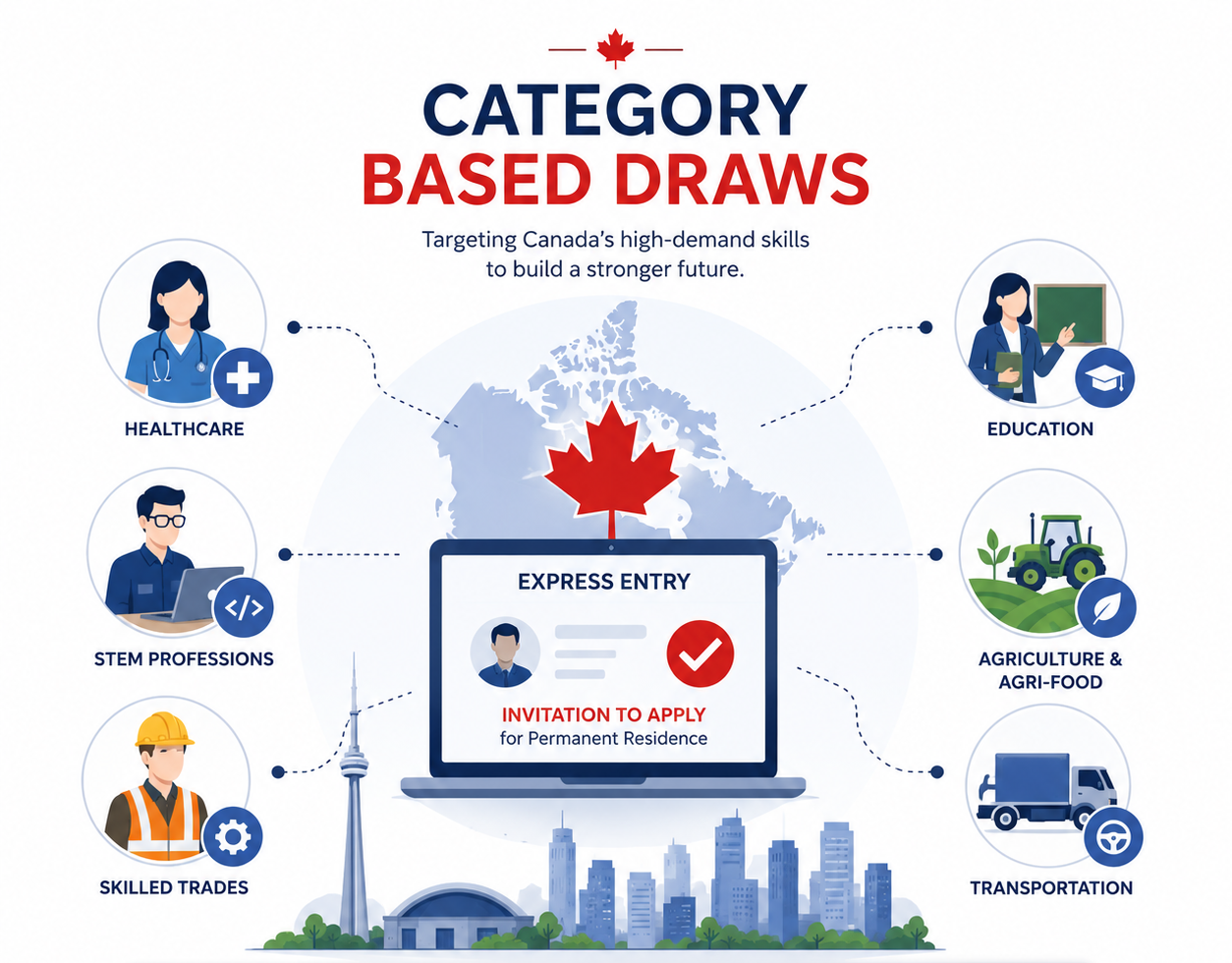
The ITA depends on your CRS ranking; if your CRS score is above the cut-off mark, you will receive an invitation. There are two types of draws: the general draw and the category-based draw. In a general draw, all candidates are considered, while a category-based draw narrows the selection to a specific group of applicants.
Category draws are one of the newest features of the Express Entry System, as they select candidates with occupations or skills from certain categories rather than from all possible choices.
The occupations covered in these draws are selected because they face labour shortages, such as healthcare, IT, trades, agriculture, and others. Being fluent in French is also a category, which reflects Canada’s efforts to support Francophone communities outside Quebec.
If your occupation falls into one of the categories that are currently active, you will get an invitation to apply to the Express Entry even if you don’t have as many CRS points as the regular draws usually require. These categories are periodically revised and updated depending on the labour market conditions.
Provincial Nominee Programs
Alberta

The Alberta Immigrant Nominee Program (AINP) has multiple streams for skilled workers and in-demand occupations. Those already employed in Alberta with a valid job offer can apply directly under the Alberta Opportunity Stream.
Priority sectors typically include healthcare, technology, agriculture, and skilled trades, reflecting the province’s evolving labour market. You will get an extra 600 points if you are nominated, and this can make a big difference to your Express Entry ranking.
Alberta also holds occasional targeted draws for occupations with severe shortages. Alberta’s cost of living is still reasonably inexpensive when compared to some other provinces, which is a great draw for newcomers. If your occupation matches current provincial priorities, Alberta offers one of the more accessible PNP pathways available today.
British Columbia

The British Columbia Provincial Nominee Program (BC PNP) is famous for offering fast-track options, especially to tech workers.
Within the Tech Pilot stream, eligible technology occupations can bypass some regular requirements, making the process faster. Healthcare professionals also have separate streams to help address the province’s staffing needs.
Entrepreneurs may apply for the BC PNP Entrepreneur Immigration stream. It requires a qualifying business investment and a managerial position. The program uses a points system and evaluates skills, salary, and other criteria.
British Columbia often holds invites in periodic draws and selects specific sectors and skills. Large cities such as Vancouver and Victoria are popular destinations; however, some smaller towns also actively seek immigrants via their regional streams. The nomination earns 600 extra CRS points, thereby significantly increasing your chances in the Express Entry pool. For tech and healthcare workers, British Columbia remains one of Canada’s fastest and most responsive provincial immigration programs.
Manitoba

The Manitoba Provincial Nominee Program (MPNP) has a Skilled Worker stream and a Business Immigration stream. For the Skilled Worker Stream, applicants must have a job offer and/or have ties to Manitoba, including prior study or work experience.
The Business Investor Stream is geared toward people who are ready to invest in and actively operate a business in Manitoba. Manitoba uses an Expression of Interest system, ranking candidates based on factors like adaptability, skills, and labour market connections.
Priority occupations tend to be in areas of local economic need, such as health care, manufacturing, and skilled trades. The province also has strong links with overseas communities and supports smoother settlement for newcomers.
Nominated applicants get 600 more CRS points, which significantly improves their Express Entry score. Winnipeg, Manitoba’s capital, remains a major source of immigration, with smaller centers also actively seeking skilled immigrants.
New Brunswick

The New Brunswick Provincial Nominee Program (NBPNP) is a program for skilled workers, graduates, and entrepreneurs who want to become permanent residents of New Brunswick.
Under the Skilled Worker Stream, applicants need a valid job offer from a New Brunswick employer in an eligible occupation. International students who have recently graduated from a recognized institution in New Brunswick are eligible to apply through streams targeted at New Brunswick graduates.
The Entrepreneurial Stream requires an eligible business plan and investment and is for entrepreneurs interested in starting or buying a business. New Brunswick also has an Express Entry stream, which means candidates in the federal stream can apply directly and be processed more quickly.
Priority sectors may include healthcare, skilled trades, and IT, which are in short supply in the region. Nominated applicants will receive 600 points, which will greatly strengthen their application. Cities like Fredericton, Saint John, and Moncton offer growing opportunities alongside a lower cost of living.
Newfoundland and Labrador

The Newfoundland and Labrador Provincial Nominee Program (NLPNP) is for both international graduates and skilled workers. With the Skilled Worker Stream, candidates must receive a job offer from a domestic employer in a qualified profession.
Recognized Canadian institutions, such as those in the province, offer special graduate streams for international graduates. The program focuses on sectors such as healthcare, technology, and natural resources, among others, which are among the province’s economic priorities. Applicants already linked to Express Entry can apply through an aligned stream to speed up processing.
Newfoundland and Labrador also prioritizes long-term settlement; they want applicants to establish long-term connections within communities. If nominated, your Express Entry ranking improves by 600 CRS points.
With cities like St. John’s offering growing job markets, alongside more affordable housing compared to larger provinces, this program appeals to newcomers seeking both career opportunities and a manageable cost of living.
Northwest Territories

The Northwest Territories Nominee Program (NTNP) relies primarily on employer-driven nominations for critical local roles. Under this structure, applicants generally need a confirmed job offer from an employer operating within the territory.
Employer sponsorship is a key component in the Northwest Territories’ unique labour shortage challenges, especially in healthcare, education and skilled trades. The program is intended to complement the recruitment needs from the local labour market. Relevant work experience and qualifications, which meet the advertised position, are usually required. Nominations are more focused, as there are fewer people to choose from than in larger provinces. You will get 600 points for Express Entry if nominated. Some communities, such as Yellowknife, provide special opportunities, and these tend to come with higher pay due to the remoteness of the area. This program is a direct, employer supported path to permanent residence in Canada for applicants who are willing to live in the north.
Nova Scotia

The Nova Scotia Nominee Program (NSNP) offers both demand-based and entrepreneur-focused streams for eligible applicants. Under the Nova Scotia Demand: Express Entry stream, candidates in specific high-demand occupations can apply directly without needing a prior job offer. The Entrepreneur Stream is for individuals who intend to start or buy a business in the province. Priority sectors generally include healthcare, skilled trades, and hospitality, which continue to have increased labour demand in the region.
In addition, Nova Scotia conducts occupation-specific draws focused on occupations with worker shortages at that time. The province strongly emphasizes community integration and welcomes newcomers in rural and urban settings.
If you are nominated, you receive an additional 600 points to your CRS score, and this greatly improves your Express Entry profile. Halifax, as the province’s economic centre, and smaller coastal cities offer a mix of career prospects and lifestyle appeal for newcomers seeking a slower-paced, community-oriented lifestyle.
Ontario

The Ontario Immigrant Nominee Program (OINP) stands as one of the largest and most active PNPs in Canada. It has several streams, including technology, trades, and business categories, reflecting the province’s economic diversity. The Human Capital Priorities Stream targets Express Entry candidates in specific in-demand occupations, often through targeted draws. The Skilled Trades Stream is for tradespeople who have an offer of a job in an eligible occupation. The Entrepreneur Stream is for entrepreneurs who meet the business investment and activity requirements.
Ontario has been sending out Expression of Interest (EOI) invitations directly to the top-ranked candidates. Ontario is also sending direct Express Entry (EE) invitations to the highest-ranked candidates. With Ontario’s diverse and large economy, priority sectors include healthcare, IT, manufacturing, and finance. If nominated, you will receive 600 more CRS points, which will significantly boost your rank. Ontario remains a great place for skilled immigrants to settle long-term in Canada, with major cities such as Toronto and Ottawa offering strong job opportunities.
Prince Edward Island

The Prince Edward Island Provincial Nominee Program (PEI PNP) offers business and skilled worker streams tailored to island industries. The Skilled Worker Stream requires applicants to have a job offer from a PEI employer in a qualified occupation. The Business Impact Category is for entrepreneurs who wish to start or invest in a business on the island. Priority sectors can vary depending on the region’s economy, such as agriculture, fisheries, healthcare, and tourism, which are unique to PEI.
The program is based on an Expression of Interest system, with candidates ranked according to their adaptability, skills, and connection to the province. PEI places an important emphasis on long-term settlement and active engagement in local communities. If nominated, your Express Entry ranking increases by 600 CRS points.
Saskatchewan

Saskatchewan Immigrant Nominee Program (SINP) is one of the busiest PNPs, with a broad spectrum of occupations. The International Skilled Worker Category is for those with a job offer or an in-demand occupation to apply for directly.
The Saskatchewan Experience Category is for temporary workers and international graduates already settled in Saskatchewan. Entrepreneurs can choose from the Entrepreneur and Farm Categories, which are both investment- and business-qualified. Saskatchewan regularly issues invitations through both Expression of Interest draws and occupation in-demand lists.
The priority sectors are usually the areas with a wide economic base, such as agriculture, health services, trades, and technology, which is what the province has. Nominated applicants will add 600 more CRS points to their Express Entry profile, a significant boost.
Cities such as Saskatoon and Regina offer expanding employment opportunities and, in fact, a lower cost of living, and Saskatchewan continues to draw in immigrants looking for long-term employment opportunities.
Yukon

The Yukon Nominee Program (YNP) is largely based on employer nomination of skilled and semi-skilled workers. This structure typically requires a candidate to have a job offer from a Yukon employer.
Employer sponsorship is an integral part of the nomination process in Yukon because of the province’s unique labour needs, including in the tourism, trades, and health care sectors. The program includes both skilled and semi-skilled occupations, and has wider eligibility criteria than some other provinces.
Most applicants will need relevant experience and qualifications that match the position they applied for. In Yukon, with a smaller population, nominations are more likely to be related to specific and confirmed employment. Your CRS score will be boosted by 600 points, which will help increase your Express Entry score if you are nominated.
Please Note: A provincial nomination adds 600 points to your CRS score if linked to Express Entry.
Quebec Immigration

Quebec Skilled Worker Program
The Quebec Skilled Worker Program (QSWP) is a points-based selection process for skilled immigrants intending to immigrate to Quebec. Your application is assessed under the Regular Skilled Worker Program (RSWP) grid, which evaluates factors like age, education, work experience, and language ability. French language proficiency is especially important in Quebec since it is a separate immigration system. Strong results in French language tests, alongside functional English, can meaningfully strengthen your profile.
Your occupation should also match occupations that are experiencing a labour shortage in the province. Most applicants apply through the Expression of Interest system, meaning they submit a profile and are invited only if they meet the requirements.
After you are selected, you must apply for a Quebec Selection Certificate, which is a condition for moving to the federal permanent residence category.

Quebec Experience Program
The Quebec Experience Program (PEQ) is a quicker path to permanent residency for graduates and local workers. If you completed an eligible program of study at a Quebec institution, you may qualify under the graduate stream. On the other hand, if you have 12 to 24 months of full-time experience in Quebec, depending on your job, you can apply through the worker stream. Fluency in French is still required, as a medium-advanced level in oral communication is needed.
The PEQ is often more appealing for individuals with a good local reputation, as it is generally processed more quickly than the standard skilled worker program. This program targets candidates who have already become part of Quebec’s language, culture, and workforce. Upon approval, you will receive a Quebec Selection Certificate, which will allow you to move on to federal permanent residence. This remains one of the most convenient immigration routes for international graduates and temporary workers already settled in Quebec.

Expression of Interest System
The Expression of Interest (EOI) system is the first step in which you will formally express your interest in immigrating to Quebec. Instead of applying for a position, you first build a detailed profile of your education, work experience, and language skills. Quebec keeps this profile in its selection pool for a specified period, usually 12 months.
The government periodically evaluates submitted profiles and issues invitations based on labour market demand and provincial priorities. Invitations are not guaranteed, and the strength of your profile increases with French language ability and in-demand occupation.
This system enables Quebec to recruit candidates whose skills closely align with the province’s economic needs. If you are not chosen during the active time, you may have to submit a new profile.
Arrima Portal
Arrima is Quebec’s official online platform for managing your immigration application process. You first use this system to submit your Expression of Interest, which outlines your background and qualifications. After you’re invited, you can complete and submit your application and all supporting documents through the portal. Arrima also lets you monitor your application status, ask questions for more information, and receive official updates directly.
The platform brings everything together, so it’s crucial to keep your profile updated and accurate throughout. Applicants need to stay updated with the website for changes in the draw criteria, updated priorities, and new draw rounds. There is a certain benefit in knowing how the system works, as it will help you avoid delays or missed deadlines during critical stages. Arrima is the main application management system used in Quebec and is involved in almost all aspects of the Quebec immigration process, from the application to the final certificate.

Quebec Immigration Levels Plan
The Quebec Immigration Levels Plan sets the province’s total immigration levels by category for each year. This plan is issued annually and outlines the numbers expected to be processed in the economic, family, and humanitarian streams of immigration.
Reviewing this document helps you understand which programs are being prioritized during a given period. Economic immigration quotas, for example, can be raised, which can lead to more invitations through programs such as the Quebec Skilled Worker Program.
The plan also considers broader provincial priorities, such as sectors or regions experiencing labour shortages. As Quebec determines its own immigration targets, this document offers valuable planning information for applicants. This insight into the current priorities will also help you plan your application wisely, especially if some streams seem to be gaining in popularity.
Quebec Immigration Pilot Programs
Occasionally, Quebec offers pilot immigration programs that target sectors experiencing labour shortages. Currently, these pilot programs mostly include industries such as artificial intelligence, information technology, and agri-food processing. Eligibility requirements for pilot programs tend to be less stringent than those for regular programs, as long as certain industry requirements are met.
For instance, candidates working in the artificial intelligence industry could benefit from simplified procedures, given the growth of Quebec’s technology sector. Similarly, agri-food pilots address ongoing shortages within food production and processing industries. Because pilot programs are temporary and specific to a certain industry, they could vary based on labour market needs. If your profession is included in one of the sectors, then the pilot program could be a fast track for you.
Key Resources You Should Not Ignore
National Occupational Classification (NOC)
The National Occupational Classification (NOC) system classifies all occupations in Canada in the same way. Every job has an NOC code and a Training, Education, Experience, and Responsibilities (TEER) designation. This classification is directly linked to many economic immigration programs, such as Express Entry and some Provincial Nominee Programs. The NOC code used to apply must be the correct one for the actual duties that you perform, rather than the job title. An incorrect code may cause eligibility issues or even lead to denial later in the process.
Additionally, most programs have specific requirements for your foreign work experience in terms of TEER 0, 1, 2, or 3, which refer to managerial, professional, and technical positions. Periodic updates to the NOC system are still made, so checking the latest version is always important. Knowing your occupational classification is the first step in the process of deciding which immigration routes in Canada apply to you.

Language Test Requirements
Language test requirements form a critical component of nearly every Canadian immigration application. English proficiency is accepted through IELTS or CELPIP, and French proficiency is accepted through TEF or TCF. Your test scores are translated into Canadian Language Benchmark (CLB) levels, which directly affect your Express Entry CRS score. Your overall ranking can be improved by higher CLB levels, especially CLB 9 or higher. Many programs also have minimum thresholds, which means that low scores will make you ineligible. Test timing is important as test results are only valid for 2 years. Some applicants opt to take tests strategically to improve on certain skills such as writing or speaking. Being able to speak French, even at a low level, opens more draws and/or bonus CRS points. One of the best things you can do is to prepare well for the test you’ve selected to help support your immigration application.
Educational Credential Assessment (ECA)
An Educational Credential Assessment (ECA) verifies that your foreign degree, diploma, or certificate is at or above the Canadian standards recognized by the government. This assessment is usually required for programs such as the Federal Skilled Worker Program to prove that your education is legitimate and comparable to Canadian education.
These evaluations are completed by designated organizations, like World Education Services (WES) or IQAS, based on a transcript and documents that have been submitted. This typically takes a couple of weeks, so applicants should apply for their ECA well before creating an Express Entry profile.
Your ECA result has a direct impact on your CRS score, as education level scores significantly towards your overall points. It is important to have your documents ready early, as missing or outdated documents can cause delays. In addition, some provinces have their own specific credential assessments for the Provincial Nominee Programs. Plan your ECA so you don’t create unnecessary gaps in your application, since it’s valid for 5 years. It remains a key requirement for most skilled immigration streams.

Immigration Levels Plan
The Immigration Levels Plan outlines multi-year objectives for Canada’s total immigrant level in each major category. This plan is issued annually and estimates expected numbers in the economic, family, and refugee streams.
Examining the existing targets tells you which programs the Government is actively targeting at a particular time. More economic targets can mean more Express Entry invitations or larger category draws, for instance. The plan also accounts for national priorities such as labour market demand and regional settlement objectives.
Levels may change due to economic and political shifts, so it is important to stay up to date and set realistic expectations for processing times. This document essentially serves as a roadmap, indicating how many applicants Canada plans to welcome, and through which specific pathways. Knowing these targets will help you strategically time your application, especially if application volumes are increasing in some categories.
About IRCC
Immigration, Refugees and Citizenship Canada (IRCC) is the federal department that regulates the immigration programs across Canada. IRCC handles applications for visas, permanent residency, citizenship ceremonies, refugee resettlement and more.
It formulates policies, processes applications and liaises closely with the provinces on programs such as Provincial Nominee Programs. IRCC also manages important digital platforms, such as Express Entry, where the majority of economic immigration applications are processed.
In addition to processing applications, the department releases key resources, including the Immigration Levels Plan and program eligibility criteria. IRCC collaborates with other government departments, such as border services and employment agencies, to support coordinated national immigration management. Understanding how IRCC works will help applicants communicate with the agency, understand processing times, and know what documentation is required.