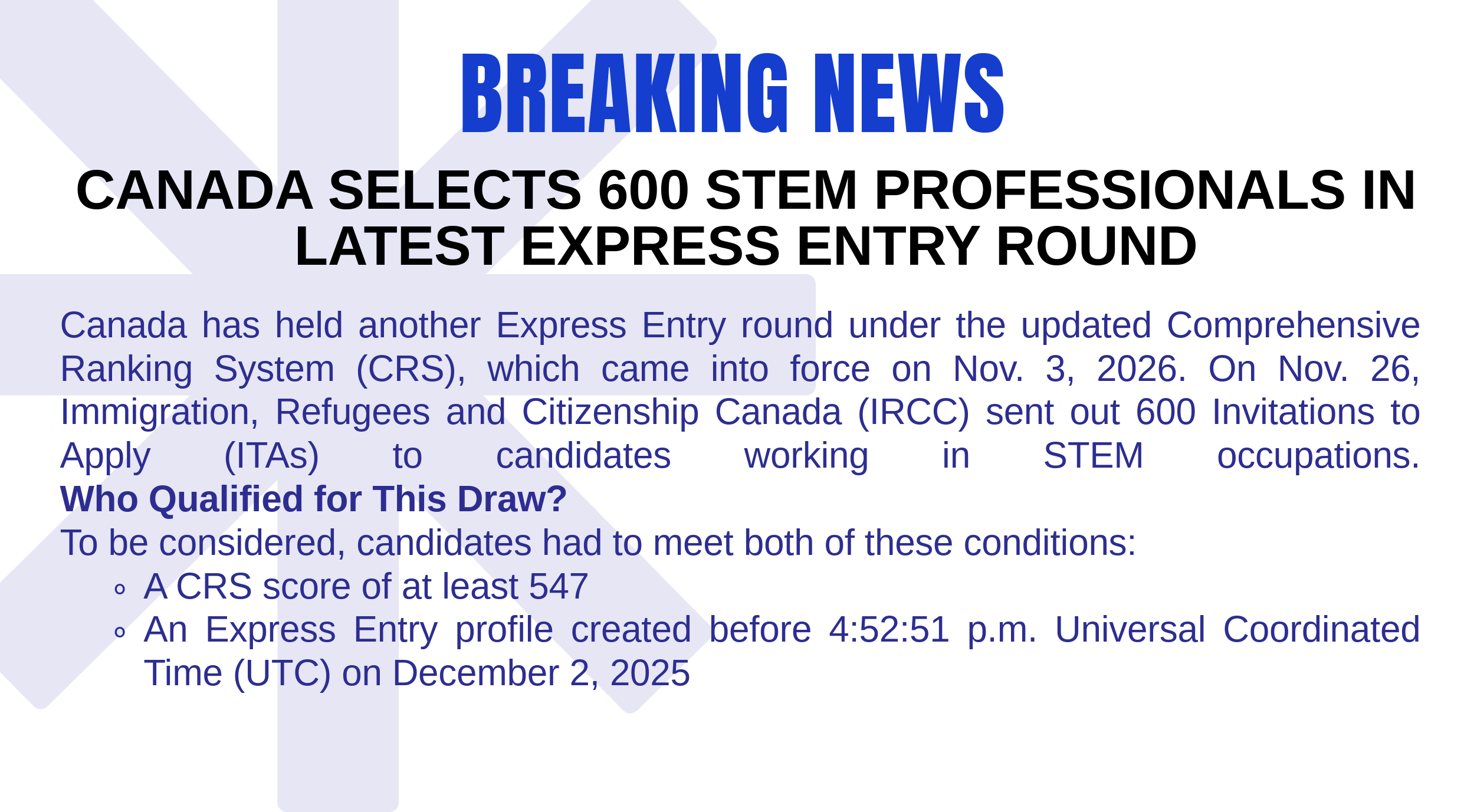


Great news for skilled workers dreaming of life in Canada: Express Entry has just received an exciting update. In late 2026, Canada updated three key areas of the system, namely eligibility criteria, the way points are awarded and job offer requirements. The first set of changes took effect on November 3, 2026, and the second followed on November 17.
Notably, a new Labour Market Integration factor now gives you extra recognition for Canadian work experience and high-wage jobs. In addition, job offers no longer need an LMIA, and researchers benefit from updated eligibility rules. Together, these updates could open new ways for you to strengthen your Comprehensive Ranking System score and improve your chances of receiving an invitation.
So, how can you make the most of them? Read the full blog to learn exactly how each change works, how your points are calculated and which steps you should take next.
Understand How Express Entry Works
Express Entry is an online system that Canada uses to manage immigration applications under three programs:
- Canadian Experience Class (CEC): for skilled workers with eligible Canadian work experience.
- Federal Skilled Worker Program (FSWP): for skilled workers with eligible foreign or Canadian work experience.
- Federal Skilled Trades Program (FSTP): for skilled workers who are qualified in a skilled trade.
Before comparing these programs, you should know three terms:
- Canadian Language Benchmark (CLB): the Canadian standard used to measure the English language ability of immigrants.
- National Occupational Classification (NOC): a list of all the occupations in the Canadian labour market.
- Training, Education, Experience and Responsibilities (TEER): the NOC has six TEER categories. Each category reflects the education and training an occupation needs.
How the Three Programs Compare
Language Skills
- CEC: CLB 7 for TEER 0 or TEER 1 occupations, and CLB 5 for TEER 2 or TEER 3 occupations.
- FSWP: CLB 7.
- FSTP: CLB 5 for speaking and listening, and CLB 4 for reading and writing.
Type of Work Experience
- CEC: Canadian work experience in an occupation listed in one or more of these categories: TEER 0, TEER 1, TEER 2 or TEER 3.
- FSWP: Work experience in an occupation listed in one of these categories: TEER 0, TEER 1, TEER 2 or TEER 3.
- FSTP: Work experience in a skilled trade under the following key groups of TEER 2 or TEER 3:
- Major Group 72, technical trades and transportation officers and controllers, excluding Sub-Major Group 726, transportation officers and controllers
- Major Group 73, general trades
- Major Group 82, supervisors in natural resources, agriculture and related production
- Major Group 83, natural resources and related production
- Major Group 92, processing, manufacturing and utilities supervisors, and utilities operators and controllers
- Major Group 93, central control and process operators and aircraft assembly assemblers and inspectors, excluding Sub-Major Group 932, aircraft assemblers and aircraft assembly inspectors
- Minor Group 6320, cooks, butchers and bakers
- Unit Group 62200, chefs
Amount of Work Experience
- CEC: One year in Canada within the last three years. Full-time and part-time work can both count.
- FSWP: One continuous year within the last 10 years. You can combine part-time work, full-time work or more than one job in your primary occupation.
- FSTP: Two years within the last five years. Again, full-time and part-time work can both count.
Job Offer
- CEC: Not required.
- FSWP: Not required. However, a valid job offer can earn you selection criteria points.
- FSTP: Required. You need either a valid job offer of full-time employment for a total period of at least one year, or a certificate of qualification in the skilled trade. That certificate must be issued by a Canadian provincial, territorial or federal authority.
Education
- CEC: Not required.
- FSWP: Secondary education is required, and your post-secondary education can earn you more selection criteria points.
- FSTP: Not required.
How to Check Whether You Are Eligible

You can answer a questionnaire to find out whether you meet the minimum requirements of Express Entry. There are two ways to do this.
Option 1: The Come to Canada tool. Answer a few questions to assess your eligibility. At the end, it gives you a personal reference code. You will then use this number to move your information from the tool into your Express Entry profile.
Option 2: Your IRCC secure account. Sign in and choose "Apply to come to Canada" under "Start an application." Next, choose "Express Entry" under "I do not have a Personal Reference Code." Finally, answer the questions.
A Quick Word on the Provincial Nominee Program
If you are eligible for one of these programs, you can also apply through Express Entry for the Provincial Nominee Program (PNP). A nomination brings extra points, so you can be invited to apply quickly.
Changes Effective November 3, 2026

These updates affect the points for Canadian work experience and job offers. They fall into two groups: changes to CRS points and changes to job offers.
A New CRS Factor: Labour Market Integration
The Comprehensive Ranking System (CRS) now includes a new factor called Labour Market Integration. It awards points for either of the following:
- Your Canadian work experience, based on how long you worked, with extra points for work in eligible high-wage occupations.
- A qualifying job offer in an eligible high-wage occupation.
You can receive points for Canadian work experience or for an eligible job offer, but not both.
What Is a High-Wage Occupation?
Under Express Entry, a job is a high-wage occupation when its median wage is at least 1.3 times the average median wage of the overall Canadian workforce. This figure comes from all the people in Canada who work under the same NOC. It is not based on your specific job position.
These occupations are grouped into three levels using NOC codes, and points are awarded according to those levels. Only jobs on these three levels qualify for high-wage occupation points or job offer points under this factor. You can check the official list to find out which jobs are eligible.
How the Factor Is Calculated
To work out your score, IRCC compares the points you could receive from your Canadian work experience in the last 10 years with those from a qualifying job offer. You get whichever gives you more CRS points. The maximum for this factor is 150 points.
| Score option | With a spouse or common-law partner | Without a spouse or common-law partner |
|---|---|---|
| Canadian work experience | 140 points (70 for work-length + 70 for high-wage experience) | 150 points (80 for work-length + 70 for high-wage experience) |
| Qualifying job offer | 100 points | 100 points |
Canadian Work Experience Points
Canadian work experience points combine two parts: work-length points and high-wage occupation points.
Work-length points. These are the same CRS points already awarded for qualifying work experience in the last 10 years in any TEER 0 to 3 NOC. The eligibility requirements for Canadian work experience are not changing.
| Length of Canadian work experience | With a spouse or partner (max 70) | Without a spouse or partner (max 80) |
|---|---|---|
| None or less than a year | 0 | 0 |
| 1 year | 35 | 40 |
| 2 years | 46 | 53 |
| 3 years | 56 | 64 |
| 4 years | 63 | 72 |
| 5 years or more | 70 | 80 |
High-wage occupation points. These are extra points for qualifying Canadian work experience gained in eligible high-wage occupations. They are added on top of your work-length points.
To qualify, you need at least one year of qualifying Canadian work experience in the last 10 years. That means 12 months or 1,560 hours. The experience must:
- meet the existing requirements for qualifying Canadian work experience under Express Entry, and
- be gained in one or more eligible high-wage occupations.
Your eligible experience may be continuous or not. It may be full-time or an equal amount of part-time work. You can also combine it across more than one eligible high-wage job. If you worked more than one job at the same time, hours count only up to the equivalent of full-time work, which is 30 hours per week.
| Qualifying Canadian work experience | Points |
|---|---|
| At least 12 months in one or more high-wage occupations with median wages at least twice the average median wage | 70 |
| If not eligible for 70 points: at least 12 months combined in one or more high-wage occupations with median wages at least 1.5 times the average | 40 |
| If not eligible for 40 points: at least 12 months combined in one or more high-wage occupations with median wages at least 1.3 times the average | 20 |
| Less than 12 months of qualifying experience in high-wage occupations | 0 |
Skills Transferability Rules Stay the Same
The rules for skills transferability factors are not changing. Canadian work experience will still be assessed for these factors using the existing length requirements. The high-wage occupation points requirements will not apply here.
Job Offer Points Are Back
IRCC has reintroduced job offer points to the CRS. To earn them, your offer must be valid under Express Entry and be for a position in an eligible high-wage occupation. These points are assessed as part of the Labour Market Integration factor.
| Job offer category | Points |
|---|---|
| A job in a high-wage occupation with at least twice the average median wage | 100 |
| A job in a high-wage occupation with at least 1.5 times, but less than twice, the average median wage | 70 |
| A job in a high-wage occupation with at least 1.3 times, but less than 1.5 times, the average median wage | 50 |
| A job that is not in a high-wage occupation | 0 |
Changes to Job Offers
IRCC has also changed how it assesses job offers under Express Entry. As of November 3, 2026:
- You do not need a Labour Market Impact Assessment (LMIA) for a job offer to qualify for program eligibility or CRS points.
- Having an LMIA will not give you more CRS points or give your profile priority.
- Job offers may be for an existing or a new position.
- Job offers may be for an existing or a new employer.
- Officers will assess whether a job offer is genuine.
An officer still assesses every qualifying job offer when you apply for permanent residence. The officer must be satisfied that the offer is genuine before you can use it for program eligibility or to calculate your Labour Market Integration score. This review looks at both the employer and you.
The employer:
- is active in the business,
- can fulfil the terms of the offer,
- made an offer that meets their needs, and
- is following employment and recruitment laws.
You:
- are qualified and able to perform the work, and
- are likely to accept the offer and carry out the job.
How to Update Your Profile If Your Job Offer Has No LMIA

Although the requirements changed on November 3, 2026, the online system does not yet reflect this. As a result, your profile will still ask you to select that you have a positive LMIA, even though you do not need one. Under "Work history," include your job offer with these details:
| Question or field | Response |
|---|---|
| Was a positive LMIA issued for the job offer in Canada? | Yes |
| LMIA Number | 00000 |
| LMIA Issuance Date | 2026-01-01 |
| LMIA Expiry Date | 2029-01-01 |
What This Means for FSWP and FSTP Applicants
The rules for CRS job offer points differ from those that make you eligible for immigration programs. A valid job offer may still help you meet program eligibility requirements, even if the job is not on the high-wage occupation list. In other words, a job offer may qualify for program eligibility but not for CRS job offer points. IRCC assesses the two separately.
For the Federal Skilled Worker and Federal Skilled Trades Programs, qualifying job offers are not limited to high-wage occupations. They may be in any eligible TEER 0, 1, 2 or 3 job that meets the program requirements.
Changes Effective November 17, 2026
The second set of updates changed eligibility requirements and category-based selection for researchers.
- Professors and lecturers (NOC 41200): Canadian work experience and job offers can now include work paid by a Canadian entity through a stipend or other forms of funding, such as grants, bursaries and scholarships. This change supports researchers and academics who receive non-wage compensation.
- Post-secondary teaching and research assistants (NOC 41201): This work experience is no longer eligible for the Researchers with Canadian work experience category.
What Should You Do Next?
Together, these updates reward Canadian work in high-wage occupations and make job offers easier to use. Because of this, your best route to permanent residence may look different from a few months ago. Start by checking whether your occupation is on the high-wage list. Then review your work history and any job offers against the new point tables.
Every profile is different, so expert guidance can save you time and costly mistakes. At Neximm Immigration, our RCIC-led team can review your profile, estimate your CRS score and recommend the strongest pathway.